
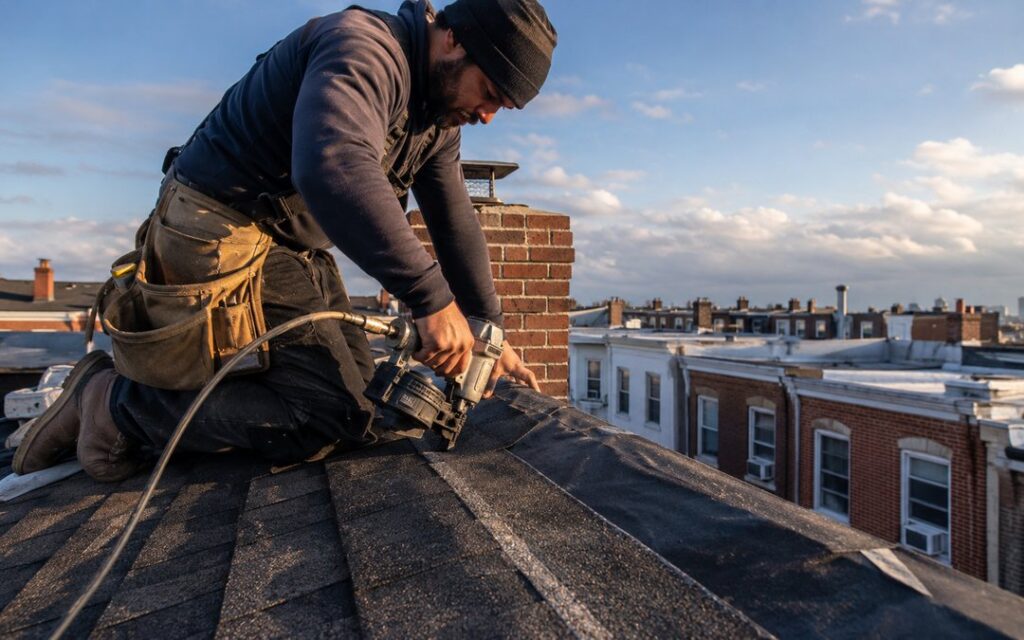
If you’ve got a damaged, leaking, or aging roof, one of the first questions you’ll run into is who to actually call. Some homeowners reach out to a general contractor. Others go straight to a roofing company. And plenty of people aren’t sure there’s a difference at all. There is — and picking the right one affects your cost, your timeline, and how long your new roof actually lasts.
Here’s what separates a roofing contractor from a general contractor, when each one makes sense, and why that choice matters more for your roof than it does for almost any other home project.
What Does a General Contractor Do?
A general contractor (GC) manages large, multi-trade projects — think home additions, full kitchen remodels, or new construction. Their job is coordination: hiring and scheduling electricians, plumbers, framers, and other specialists, pulling permits, and making sure everything comes together on time and to code. A GC is a project manager first, and a specific-trade expert second, if at all.
Most general contractors can technically take on a roofing job. Whether they should is a different question.
What Does a Roofing Contractor Do?
A roofing contractor does one thing: roofs. Installation, repair, replacement, inspections, and insurance claim support for storm and wind damage. That focus means a roofing contractor has seen far more roofs — and far more of what goes wrong with them — than a GC who handles a roof once or twice a year alongside a dozen other trades.
At NEF General Contracting, roofing is the core of what we do across Philadelphia and South Jersey: TPO, EPDM, torch down, flat roofs, and asphalt shingle installation and repair, plus siding and gutters.
Can a General Contractor Do Roofing?
Yes, in most cases a licensed general contractor is legally allowed to perform or oversee roofing work. The real question isn’t whether they can — it’s whether they’re the right choice for your specific situation.
When a GC Might Handle Your Roof
If your roof work is one piece of a much bigger project — say, a home addition that includes tying new roofline into your existing structure — having your GC oversee it as part of the whole job can make sense. They’re already coordinating the framing, the permits, and the inspections, so folding roofing into that scope avoids managing two separate contractors.
Why Specialization Matters for Roofs
Outside of that scenario, a standalone roof repair or replacement is usually better handled by a dedicated roofing contractor. Roofing has its own set of manufacturer certifications, material-specific installation requirements, and warranty rules that a GC juggling multiple trades is less likely to stay current on. A roof is also one of the few home systems where a small installation mistake — a poorly sealed flashing, an under-ventilated attic — doesn’t show up as a problem until months or years later, in the form of a leak or premature wear. That’s exactly where specialized experience pays off.
Roofing Contractor vs. General Contractor: Key Differences
Licensing & Certification
Both roles require state contractor licensing, but roofing contractors often carry additional manufacturer certifications (for specific shingle, TPO, or EPDM systems) that unlock stronger material warranties — something a generalist GC typically doesn’t have.
Experience & Expertise
A roofing contractor sees roofing failures — flashing leaks, ventilation issues, storm damage patterns — far more often, simply because it’s all they do. That repetition is where real expertise comes from.
Insurance & Warranties
Roofing-specific warranties (both material and workmanship) are usually stronger and more clearly defined when the work is done by a certified roofing contractor rather than a generalist. If you’re filing an insurance claim for storm damage, a roofing contractor is also more likely to have direct experience working with adjusters on roof-specific claims.
Cost Considerations
A GC managing a roof as part of a larger project may add a coordination markup on top of the roofing work itself, since they’re subcontracting it out or supervising it as one piece of a bigger job. Hiring a roofing contractor directly for a standalone roof project usually means paying for the work itself, without that extra layer.
That said, cost shouldn’t be the only factor. A slightly higher quote from a contractor with strong roofing-specific credentials and a solid local track record is often a better value than the lowest bid, especially given how expensive a poorly installed roof is to fix later — both in materials and in the water damage that can follow a bad install.
A Common Scenario: Storm Damage on a Philadelphia Rowhome
Here’s where this decision plays out most often for local homeowners. A storm rolls through Philadelphia or South Jersey, and you find shingles missing or water coming through the ceiling. You need someone out fast, you need accurate damage documentation for your insurance adjuster, and you need the repair done right the first time — rowhome roofs share walls and drainage systems with neighboring properties, so a rushed or improper repair can create problems beyond your own roofline.
This is a case where a roofing contractor’s narrow focus is a real advantage. A company that inspects storm damage regularly knows what an adjuster needs to see, how to document it correctly, and how local rowhome construction affects the repair. A general contractor could coordinate this too, but you’d likely be paying for a layer of project management you don’t need for a single-trade repair.
Questions to Ask Before You Hire Either One
Whether you end up with a roofing contractor or a general contractor, a few questions will tell you a lot about who you’re actually hiring:
- Who will physically perform the roofing work? A GC may subcontract it — ask who, and what their roofing-specific experience looks like.
- What manufacturer certifications does the installer hold? This directly affects what warranty coverage you qualify for.
- Do you carry both liability insurance and workers’ compensation? Roofing is physically risky work; make sure you’re not liable if someone is injured on your property.
- Can I see recent local references or completed roofing projects? Ask specifically about roofing jobs, not general renovation work.
- How do you handle insurance claims? If storm damage is involved, ask whether they’ve worked directly with adjusters before and can provide documentation support.
A contractor who answers these clearly and specifically — rather than vaguely — is generally the safer choice, regardless of which title is on their license.
When to Hire a Roofing Contractor
- Your roof needs repair, replacement, or an inspection — and that’s the only work being done
- You’re dealing with storm or wind damage and need to file an insurance claim
- You want the strongest available manufacturer warranty on materials and installation
- You’re comparing quotes and want someone who specializes specifically in roofing, not general construction
When You Might Need a General Contractor Instead
- Your roof work is part of a larger addition, remodel, or new construction project
- You need one point of contact coordinating multiple trades across a bigger scope
- Permitting and multi-trade scheduling are a bigger concern than roofing-specific expertise
Pennsylvania & New Jersey Licensing: What to Verify
Licensing rules differ by state, so it’s worth checking regardless of whether you’re leaning toward a roofing contractor or a general contractor.
In Pennsylvania, any contractor performing $5,000 or more in home improvements per year — which covers virtually every roofing job — must register with the Attorney General’s Office under the Home Improvement Consumer Protection Act (HICPA). Their registration number should appear on every contract, estimate, and ad. If you’re in Philadelphia specifically, note that the city also requires its own separate contractor license on top of the state HICPA registration — ask about both.
In New Jersey, contractors performing home improvement work — including roofing, siding, and most residential renovation — must register with the Division of Consumer Affairs under the Contractors’ Registration Act, and carry at least $500,000 in general liability insurance. Unlike Pennsylvania, New Jersey doesn’t set a minimum project dollar amount before registration is required.
Neither state’s registration is a guarantee of quality workmanship — it confirms a contractor is operating legally, not that they’re good at roofing specifically. That’s exactly why the certifications and local references discussed above still matter even once registration checks out. Whichever contractor you’re considering, ask for their registration number directly and verify it before signing anything. A legitimate contractor will provide this without hesitation.
Why Philadelphia & South Jersey Homeowners Choose NEF
NEF General Contracting has served Philadelphia and South Jersey since 2014, backed by 20+ years of ownership experience in roofing, siding, and gutters. We specialize in the work rather than treating it as one line item in a bigger job — TPO, EPDM, torch down, flat roofs, asphalt shingles, siding, and gutters, done by a team that focuses on exactly that. That means when you call, you’re talking to people who install and repair roofs every day, not a generalist juggling five other trades on your project.
The Bottom Line
If your roof is the whole project — a repair, a replacement, an inspection, or a storm damage claim — a dedicated roofing contractor is almost always the better call. Save the general contractor route for situations where your roof work is genuinely one piece of something bigger, like an addition or a full remodel. Either way, verify licensing, ask about manufacturer certifications, and don’t be afraid to ask exactly who will be on your roof doing the work.
Frequently Asked Questions
Is a roofer the same as a general contractor?
No. A roofer (roofing contractor) specializes specifically in roofing work. A general contractor manages broader, multi-trade projects and may subcontract roofing out or oversee it as one part of a larger job.
Do I need a general contractor to replace my roof?
No — for a standalone roof replacement, you can hire a roofing contractor directly. A general contractor is typically only necessary if the roof work is part of a larger, multi-trade construction project.
Will a general contractor’s roofing work be covered by warranty?
It depends on who actually performs the work and what certifications they hold. Manufacturer material warranties often require installation by a certified roofing contractor — ask about this directly before hiring, regardless of who you choose.
Can a general contractor handle a storm damage insurance claim for my roof?
They can, but a roofing contractor with direct storm-damage and insurance-claim experience is often better equipped to document damage accurately and work with your adjuster on a roof-specific claim.
Is it more expensive to hire a roofing contractor than a general contractor?
Not typically. For a standalone roof project, hiring a roofing contractor directly often costs less than routing the same work through a general contractor, since you’re not paying for an added layer of project coordination on top of the roofing labor and materials.
What should I look for when comparing roofing quotes?
Beyond price, compare licensing, manufacturer certifications, insurance coverage, warranty terms, and recent local references. A detailed, itemized quote is also a good sign — vague estimates often lead to surprise costs later.
Have a roofing question or need an estimate? NEF General Contracting serves Philadelphia and South Jersey with roofing, siding, and gutter services. Call 267-704-4132 to talk to our team.
Recent Comments